Real Estate Ads: What They Cost in 2026 (Real CPC Data)
Real estate ads cost $0.93 to $169 a click, and the keyword decides which. What agents pay, what a lead costs, and which ads are worth running.
By Yas Rajah
· 12 min read
Contents
- What a click costs (October 2026)
- What that means per lead
- So which ads are actually worth running
- Worth it: the “near me” hire terms
- Worth it: rental terms, if you do rentals
- Usually not worth it: seller keywords
- The one nobody counts: the listing itself
- The formats, briefly
- What the good ads have in common
- FAQ
- Sources
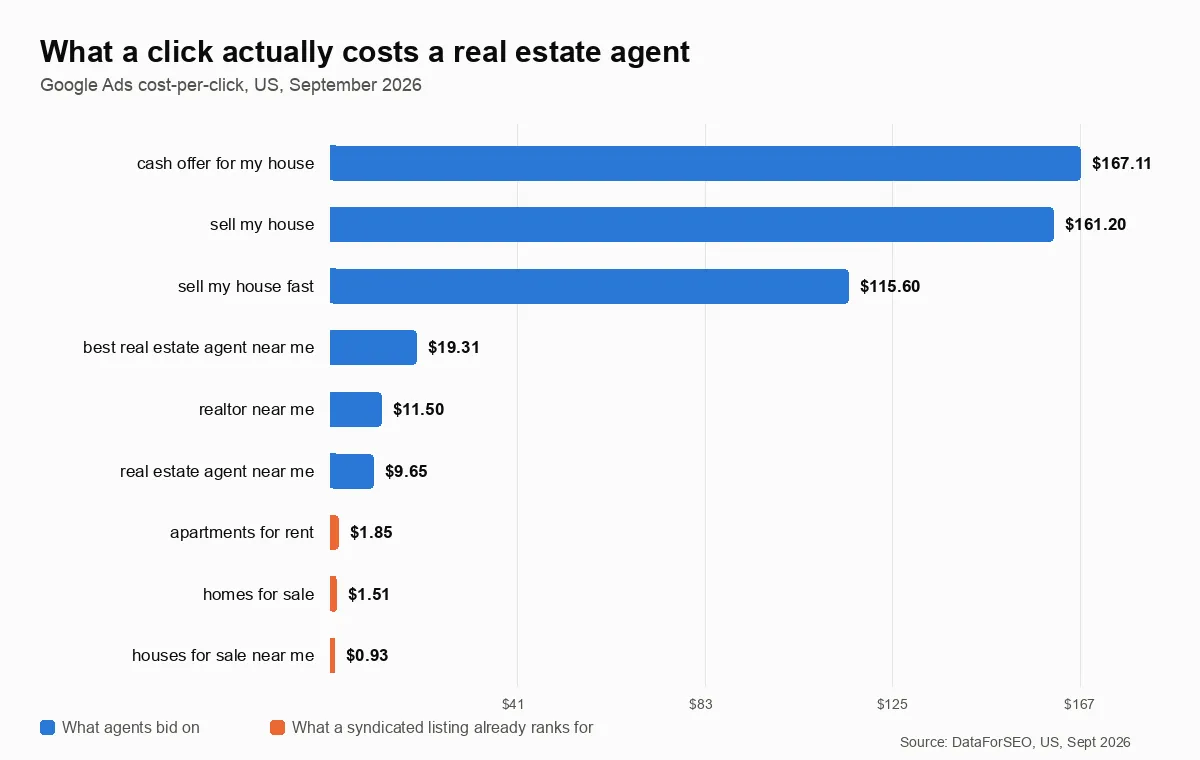
Real estate ads on Google cost between $0.93 and $169 a click in the US, and the keyword decides which end you pay. People browsing listings (“houses for sale near me”) cost under a dollar, people looking to hire an agent (“real estate agent near me”) about $10, and homeowners looking to sell (“sell my house”, “cash offer for my house”) $104 to $169, in Google’s latest figures (through August 2026). Pick the keyword whose maths can close before you spend anything on creative.
Every other article about real estate ads shows you a gallery instead: beautiful creative, a luxury listing shot at golden hour, a clever headline. Thirty-one of them. Eleven of them. Fifteen “best examples”. None of them tells you what the ad costs to run.
That’s the part that decides whether an ad works, and it’s decided before anyone writes a word of copy. The keyword you point an ad at sets the price of everything downstream. In real estate, the gap between the cheap keywords and the expensive ones isn’t 20%. It’s more than a hundredfold.
What’s changed (October 2026): we re-pulled the same 12 keywords a month after publishing. Seller clicks got cheaper: “sell my house” fell from $161.20 to $149.87 (down 7%) and “sell my house fast” from $115.60 to $103.75 (down 10%), while “cash offer for my house” edged up from $167.11 to $169. The agent-hire and listing terms moved by less than $2. We’ve also added Google’s top-of-page bid range for each term, and one rule most agents miss: Google, not just Meta, bars ZIP-code targeting for housing ads.
What a click costs (October 2026)
| Keyword | Cost per click | Top-of-page bid range | Monthly searches |
|---|---|---|---|
| cash offer for my house | $169.00 | $45.74–$148.78 | 720 |
| sell my house | $149.87 | $44.36–$139.33 | 5,400 |
| sell my house fast | $103.75 | $14.57–$106.11 | 9,900 |
| best real estate agent near me | $17.38 | $6.49–$28.53 | 14,800 |
| listing agent near me | $15.68 | $6.82–$38.79 | 1,300 |
| realtor near me | $11.01 | $3.70–$18.12 | 90,500 |
| real estate agent near me | $9.65 | $4.79–$23.49 | 40,500 |
| what is my home worth | $7.42 | $1.70–$8.58 | 8,100 |
| rental agent near me | $5.74 | $0.90–$6.34 | 8,100 |
| apartments for rent | $1.85 | $0.47–$2.54 | 550,000 |
| homes for sale | $1.51 | $0.09–$2.43 | 368,000 |
| houses for sale near me | $0.93 | $0.08–$1.32 | 550,000 |
Median across these 12: $10.33. Range: $0.93 to $169.00.
Source: Google Ads Keyword Planner data for the United States, pulled 15 October 2026 (the latest month in it is August 2026). These are what advertisers have paid, not a quote: your own cost moves with quality score, match type and how many people are bidding in your market. The bid range is Google’s own: the low end is “an approximation of the 20th percentile” of what advertisers have paid to show at the top of the page, and the high end the 80th (Google Ads Help).
Two things fall out of that table immediately.
The keywords agents most want are the most expensive things on the internet. “Cash offer for my house” at $169 a click isn’t an anomaly. It’s iBuyers and cash-buying operations with balance sheets bidding against each other for a seller who has already decided to sell. You aren’t outspending them.
The cheapest keywords have the most volume. “Houses for sale near me” is 550,000 searches a month at 93 cents. That isn’t a worse keyword. It’s a different person: someone looking at property, not looking to hire an agent.
Should you be running real estate ads at all?
Four questions, about fifteen seconds. The answer depends on your commission and how fast you answer the phone.
Question 1 of 4
What are you actually trying to get?
Question 2 of 4
What is your typical commission on a deal?
Question 3 of 4
How fast does an enquiry actually get answered?
Question 4 of 4
What can you commit to a month?
Your answer
Don't buy ads yet — the maths does not work for you
At your commission and response speed, paid search will cost more per client than it returns. Seller keywords run $104 to $169 a click, and even a good landing page turns only a few percent of clicks into leads. Get the listing itself in front of searchers first: browsing searches like "apartments for rent" cost advertisers $0.93 to $1.85 a click, and a listing syndicated to the portals reaches them without a bill.
Syndicate your rental listings free →Your answer
Bid on the cheap intent, not the expensive intent
Skip the seller terms entirely. "real estate agent near me" is $9.65 a click against $149.87 for "sell my house", and the person searching it is already looking to hire someone. Set a small budget, point it at one page about you rather than your homepage, target by city or radius (Google and Meta both bar ZIP-code targeting for housing ads), and measure cost per lead before you scale anything.
Build the page your ad points at →Your answer
You can afford seller keywords — if the follow-up is genuinely instant
High commissions and fast response are the two conditions that make $104 to $169 a click survivable. At 3% click-to-lead that's still thousands per lead, so every enquiry has to be answered in minutes. If follow-up slips even slightly, this becomes the most expensive way to lose a deal.
Why the first five minutes decide it →Your answer
You want awareness, which is a different budget and a different measure
Name recognition isn't bought on search intent: someone typing "sell my house" has a problem, not a memory. Awareness runs on social and local placement, and it should be judged on reach and recall rather than cost per lead. Don't measure it with the same spreadsheet as a lead campaign, and don't fund it from the same budget.
Marketing channels ranked by what they produce →Get new posts on real estate advertising
We'll email you when we re-pull ad costs or publish new research on what agents pay for leads.
No spam, unsubscribe anytime.
What that means per lead
A click isn’t a lead. Run the numbers on a realistic funnel.
At 3% click-to-lead, which is a reasonable figure for a decent landing page:
sell my house fastat $103.75 → $3,458 per leadreal estate agent near meat $9.65 → $322 per leadhouses for sale near meat $0.93 → $31 per lead
Then apply a close rate. At 2% of leads becoming signed clients:
sell my house fast→ $172,917 per clientreal estate agent near me→ $16,083 per clienthouses for sale near me→ $1,550 per client
Those first two numbers aren’t typos, and this is the part the examples articles never reach. The calculator above lets you put in your own conversion and close rates, because yours are the only ones that matter.
This is the whole argument of this article: the creative is rarely why an ad fails. The ad failed when someone picked a keyword whose maths could never close.
So which ads are actually worth running
Worth it: the “near me” hire terms
real estate agent near me ($9.65, 40,500 searches) and realtor near me ($11.01, 90,500) are people looking to hire someone, right now, near where they are. Ten or eleven dollars a click is survivable against a real commission.
Two rules if you run these. Point them at a page about you, not your homepage. A homepage makes someone who just asked for an agent go looking for one, and that’s where high-intent clicks leak away. And answer instantly: the Lead Response Management study found the odds of qualifying a lead drop 21 times when you call at 30 minutes instead of five (the study; popularized by HBR).
Worth it: rental terms, if you do rentals
rental agent near me at $5.74 and apartments for rent at $1.85 are the cheapest genuine intent in the category. Rental commissions are smaller, so the margin is thinner, but so is the entry price.
Usually not worth it: seller keywords
sell my house, sell my house fast and cash offer for my house cost $104 to $169 a click. The maths only survives on a high commission and genuinely instant follow-up, and even then you’re bidding against companies whose entire business is buying those clicks. The September-to-October dip doesn’t change that: at $149.87 a click and 3% click-to-lead, one “sell my house” lead still costs about $5,000.
If you want seller leads, the cheaper routes are the unglamorous ones: your past clients, your farm area, and ranking for your own market’s terms rather than renting them by the click. The real estate lead generation guide covers the channels that don’t price per click.
The one nobody counts: the listing itself
Here’s the uncomfortable comparison. Advertisers pay $0.93 to $1.85 a click for houses for sale near me, homes for sale and apartments for rent. Those are three of the highest-volume searches in the category, 1.4 million a month between them.
A listing that’s syndicated across the major portals appears in front of exactly those searchers, and nobody sends you a bill per click. That isn’t an argument that advertising is pointless. It’s an argument that you shouldn’t pay for the traffic you can already get, and should spend the budget on the traffic you can’t.
The formats, briefly
Since you came looking for ads, here are the formats that actually run in this category.
Listing ads on the portals. Zillow, Realtor.com and Apartments.com all sell placement against their own traffic, priced per market. Zillow, for one, says Premier Agent pricing “varies by market, home values, expected connections, and more” (Zillow, checked 15 October 2026).
Google Search. The table above. Highest intent, highest price, and the only channel where someone is actively asking for what you sell. Housing ads have targeting limits here too: in the United States and Canada, Google’s policy says “you can’t target using” gender, age, parental status, marital status or ZIP codes, and radius targeting needs “at least 1 km around any given location” (Google Ads policy: Housing, checked 15 October 2026). Target by city or radius instead.
Meta (Facebook/Instagram). Cheap reach, and the format most of those “best ad examples” galleries are drawn from. Housing ads fall under Meta’s Special Ad Category, and for advertisers in or reaching the US, Meta says “age, gender, ZIP code or postal code, exclusion targeting, lookalike audiences and saved audiences” are limited or unavailable (Meta Business Help, checked 15 October 2026). Promise reach, not precision. We go into this properly in Facebook ads for rental listings.
Retargeting. It only reaches people who already came to you, which is its strength and its limit: it can’t work until something is bringing people in to retarget, usually a single-property website or your listings. Superlisting builds a website for each listing from the listing link, and on its $29-a-month plan you can add your own Meta and Google tags to every page, which is what retargeting needs. Your first one is free.
Print, postcards and farm mail. Still works in a defined farm area, and it’s priced per thousand rather than per click, which makes it a different kind of decision. The open house flyer is the one piece of print almost every agent still hands out.
What the good ads have in common
The creative isn’t the main variable, but it’s still a variable. Across the examples worth studying, the pattern is dull and consistent:
- A specific property or a specific number, not an adjective. “3-bed on Elm, $429k, open Sunday” beats “Your dream home awaits.”
- One action. Book the viewing, or get the valuation. Not both.
- The agent’s actual face. Housing is a local, personal purchase, and stock photography reads as a brokerage that doesn’t exist.
- A reason the price is the price. Buyers are comparing, and an ad that acknowledges the comparison wins against one that ignores it.
- Something that still works with the sound off, because most of the impressions you buy are muted and scrolled past.
None of that is expensive. All of it is why the cheap-keyword ad outperforms the expensive-keyword ad with the same design. For the channels either side of paid, see real estate marketing ideas and the tools that own each job.
FAQ
How much should a realtor spend on advertising? Work backwards from the maths rather than picking a number. Take your average commission, decide what share of it you can give up to acquire one client, then divide by your close rate and your click-to-lead rate to find the most you can pay per click. On a $9,000 commission where you’ll spend 15% to win it, that’s $1,350 per client, which at a 2% close and 3% click-to-lead supports about $0.81 a click. That rules out most seller keywords immediately.
Are Google Ads worth it for realtors? On the right keywords, yes. On “sell my house” at $150 a click, almost never. The channel isn’t the question; the keyword is. Agent-hire terms at $9.65 to $11 a click work against a normal commission if enquiries are answered fast. Seller-intent terms at $104 to $169 generally don’t.
Is $500 a month enough for Google Ads? At $9.65 a click that buys about 52 clicks, which at a 3% conversion is roughly 1.5 leads a month. That’s enough to test whether your landing page and follow-up work, not enough to build a pipeline on. At $150 a click it buys three clicks, which tells you nothing at all.
Can you target real estate ads by ZIP code? Not on Google or Meta in the US. Google’s housing policy bars ZIP-code, age, gender, parental-status and marital-status targeting in the US and Canada, and Meta’s Special Ad Category limits ZIP code, age, gender, exclusions and lookalike audiences. Use city or radius targeting and let the ad’s price and location do the qualifying.
What is the 3-3-3 rule in real estate? It’s a buyer-readiness guideline, not an advertising one, but it comes up constantly alongside ad searches, so it’s worth clearing up. The common version is three months of living expenses saved, three months of mortgage payments in reserve, and at least three comparable homes viewed before committing. Definitions vary by source, and some write-ups apply a different 3-3-3 to evaluating rental property over three-month, three-year and longer horizons. Either way it has nothing to do with what your ads cost.
What are some effective ads for real estate agents? The ones anchored to a specific property, price and date, with one action and the agent’s real face. Specificity does the work: a named street and a real number outperform aspirational copy because a buyer can check them.
Which platform is best for real estate advertising? Google Search for people actively looking to hire or buy, Meta for cheap reach and awareness, and the portals for placement in front of buyers who are already shopping. Most agents do best starting with the portals and their own listings, because that traffic costs $0.93 to $1.85 a click to buy and nothing to earn.
How much do real estate ads cost per click? Between $0.93 and $169 in the US in Google’s latest figures (through August 2026), with a median of $10.33 across the 12 terms agents bid on most. The spread is explained by intent: browsing listings is cheap, hiring an agent sits in the middle, and selling a house is the most expensive end of the category.
Why are seller keywords so expensive? Because a homeowner who searches “cash offer for my house” is worth tens of thousands of dollars to an iBuyer or a cash-buying operation, and those companies bid accordingly. You aren’t competing with other agents for that click. You’re competing with balance sheets.
Free syndication & listing marketing
List Once. Syndicate and Market your listings. Everywhere.
Reallyo sends your rental to Zillow, Apartments.com and the rest of its 19-site rental network, then turns it into a listing page, a video, social posts and flyers. Free for one active listing, no card.
Sources
- Cost per click, top-of-page bid range and search volume: Google Ads Keyword Planner data, United States, pulled 15 October 2026 (latest month: August 2026); the September figures were pulled 13 September 2026. Both datasets are saved with this article. Bid-range definitions: Google Ads Help, About Keyword Planner forecasts.
- Lead response timing: Lead Response Management Study (Oldroyd, MIT Sloan, 2007) and Oldroyd, McElheran & Elkington, The Short Life of Online Sales Leads, Harvard Business Review, 2011.
- Housing-ad targeting rules, checked 15 October 2026: Google Ads policy, Housing in personalized advertising; Meta Business Help, Special Ad Categories. More on Meta in Facebook ads for rental listings.
- Portal ad pricing: Zillow Premier Agent, checked 15 October 2026.