Open House Flyer Examples: What Actually Gets Called Back
Open house flyer examples, what belongs on one, how many to print, and the mistake that makes most of them useless — they are designed to be read at the house instead of after it.
What should your open house flyer actually do?
Four questions, about fifteen seconds. The right flyer depends on who is walking through the door.
Question 1 of 4
Who are you expecting on the day?
Question 2 of 4
What happens after someone takes a flyer today?
Question 3 of 4
How many other homes will they see that day?
Question 4 of 4
What is the property competing on?
Your answer
Build it as a lead-capture device, not a brochure
With real buyers walking through, the flyer's job is to still be working after they leave. Put a direct mobile number and a QR to the listing page on it, and keep the property detail short — they are standing in the property, they do not need it described. Then contact whoever scans within the hour, because the odds of qualifying a lead are far higher in minutes than in days.
Give every listing its own page →Your answer
Make it survive the comparison
If they are seeing several homes, your flyer is going into a pile on a kitchen table tonight. It has to identify itself instantly — address and price large at the top — and give them three checkable facts (taxes, HOA, year built) that the other flyers will not have. Specifics win a comparison; adjectives lose one.
What to write so it reads as real →Your answer
The neighbours are the point — treat it as farming
Neighbour traffic is not a wasted open house. Those visitors are the most likely future sellers on that street, and they are in your property voluntarily. Put yourself on the flyer more prominently than usual, add a line about what homes nearby have sold for, and treat every one as a listing conversation rather than a buyer lead.
Marketing channels ranked by what they produce →Your answer
Fix the tracking before you redesign anything
If you cannot tell who took a flyer, no amount of design will help — you have no way to know what worked. A QR pointing at the listing's own page turns an anonymous paper handout into a measurable visit, and it tells you which open house actually produced interest. Get that in place first, then worry about the layout.
Give every listing its own page →Want the open house flyer checklist?
We'll send the one-page checklist of what belongs on a flyer, how many to print, and the follow-up sequence for the people who take one.
No spam, unsubscribe anytime.
Search for open house flyer examples and you get template galleries — hundreds of layouts, sorted by colour. Pick one, drop in a photo, print.
What none of them tell you is the thing that decides whether the flyer works: it is not read at the open house. It is read in a car, or on a kitchen table that night, next to three other flyers from three other houses. Everything about how you design it should follow from that.
A flyer that explains the property is redundant — the visitor is standing in the property. A flyer that survives the drive home, identifies itself instantly against the competition, and gives someone a way to act tonight is a different document.
What belongs on one
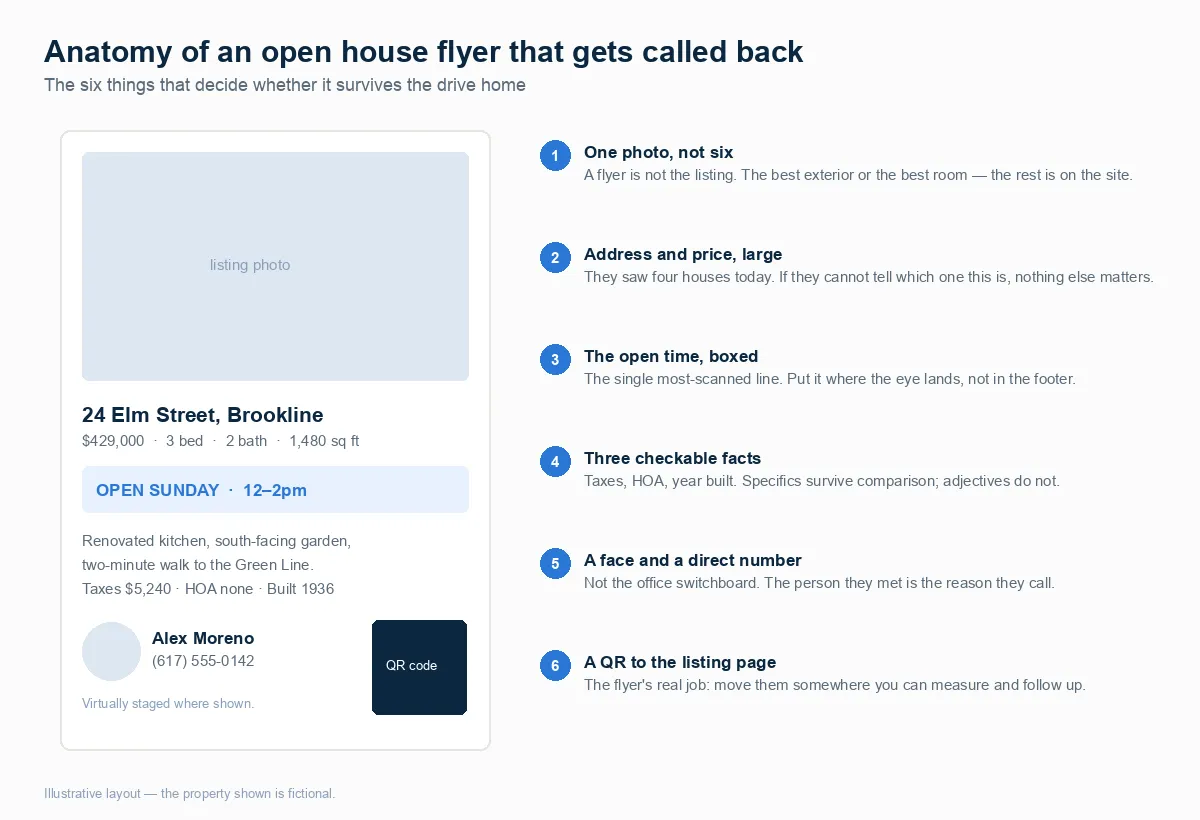
Six things, in roughly this priority. The layout at the top of this page shows them in place.
1. One photo, not six. The flyer is not the listing. Use the strongest exterior or the single best room. Six thumbnails at flyer size is six things nobody can see.
2. The address and price, large. This is the one people get wrong most often, because it feels obvious in the moment. It is not obvious at 9pm when they are holding four flyers and trying to remember which house had the good kitchen.
3. The open time, boxed. If the open house is ongoing or repeating, this is the most-scanned line on the page. It belongs where the eye lands, not in the footer with the brokerage licence text.
4. Three checkable facts. Property taxes, HOA fee, year built. Square footage if it is favourable. These do the work adjectives pretend to do — a buyer comparing two flyers can act on “$5,240 taxes, no HOA” and cannot act on “beautifully appointed”.
5. A face and a direct number. Not the office switchboard. The person they met at the door is the reason they will call, and a photo is what connects the flyer to that memory.
6. A QR code to the listing’s own page. This is the flyer’s real job, and the next section is about why.
If you have virtually staged any of the photos, say so on the flyer. Most MLSs require the disclosure anyway, and a buyer who walks into an unfurnished room after seeing a furnished photo notices — the rules vary by MLS and California made it statutory in 2026.
The mistake: a flyer that cannot be measured
Most open house flyers are a dead end. Someone takes one, leaves, and you never learn whether they read it, whether they shared it with a partner, or whether they were interested at all. You have handed out forty pieces of paper and gained nothing you can act on.
A QR code pointing at the listing’s own page changes that completely. The scan is a visit you can see. You learn which open house produced real interest, how long people spent on the page afterwards, and — if the page captures enquiries — who to contact.
That is also why the destination matters. A QR that points at a portal listing sends your open house traffic to a site that will show them four competing properties. A QR that points at the property’s own page keeps them on the one house you are selling.
How many should you print
There is no universal number, and anyone quoting one is guessing. The sensible way to arrive at it:
- Expected attendance. Ask the listing agent’s own history in that area and that price band rather than a rule of thumb.
- Add the neighbours. Open houses draw neighbourly curiosity, and those people are the most likely future sellers on the street. That is not wasted paper.
- Add a handful for the sellers themselves and for anyone who asks after the event.
- Round up modestly. Running out at 1pm is a worse outcome than twenty in the recycling — the marginal cost of the extra flyers is trivial against a missed conversation.
The more useful question is what happens to the ones you hand out. Forty flyers with no QR and no follow-up is worse than fifteen that are tracked.
The follow-up is most of the value
The flyer gets someone to the page. What happens next decides whether any of it mattered.
The classic Lead Response Management study found the odds of qualifying a lead were 21× higher when contacted within five minutes rather than thirty. That study measured general sales leads rather than open house visitors, so treat it as a principle rather than a precise figure — but the direction is not controversial. Someone who scanned your QR at 1:40pm is warm at 1:45pm and cold by Tuesday.
The calculator above puts numbers on that gap for your own response time.
Common flyer mistakes
- Describing the house to someone standing in it. Save the description for the listing page.
- Brokerage branding bigger than the property. Nobody at an open house is choosing a brokerage.
- A generic “contact us” with an office number. They met a person; give them that person.
- No date anywhere. Flyers circulate for weeks. An undated flyer for a sold property is a bad phone call.
- Stock photography of a different house. It happens more than you would think, and buyers spot it instantly.
- Printing on flimsy paper. This is the only item on the list that costs money, and it is the one that decides whether the flyer is still intact by the evening.
FAQ
What should be on an open house flyer?
One strong photo, the address and price in large type, the open house time, three checkable facts (taxes, HOA, year built), the agent’s photo and direct number, and a QR code to the listing’s own page. Keep the property description short — the reader is standing in the property.
How many flyers should I print for an open house?
Base it on expected attendance in that area and price band, add extra for neighbours who drop in, a few for the sellers, then round up. There is no reliable universal number, and running out mid-afternoon costs you more than the extra printing does.
How do I create an open house flyer?
Start from the listing photos you already have, put the address, price and open time at the top, add three verifiable facts, then your photo, direct number and a QR to the listing page. Free tools will produce the layout; the content decisions above are what make the difference.
Where can I find free printable open house flyer templates?
Canva, Adobe Express and PosterMyWall all have large free template libraries, and Zillow publishes one too — we list every good source in real estate flyer templates. A template solves the layout, not the content — most templates leave far too much room for description and far too little for the address and price.
What are some catchy slogans for an open house?
Skip the slogan. “Open Sunday 12–2” outperforms anything aspirational, because the reader is deciding where to spend an afternoon rather than responding to a tagline. If you want a line with the property, make it a specific and checkable one — the walk to the station, the year of the roof.
What is the best way to advertise an open house?
The flyer is the takeaway, not the advertising. Getting people through the door is the listing being visible where buyers are already looking, plus local social and neighbour outreach. We rank the channels by what they actually produce in real estate marketing ideas, and price the paid options in what real estate ads cost.
Should an open house flyer include the price?
Yes, and prominently. A flyer without a price forces the reader to look it up, which usually means going to a portal where they will be shown competing homes. The price is also the fastest way for them to identify which house the flyer is for.
Do open house flyers still work in 2026?
As advertising, barely — they reach people who are already inside the property. As a takeaway that carries a QR code, a direct number and a face into someone’s kitchen that evening, they work fine. The failure mode is not paper; it is a flyer with nothing to act on.
Sources
- Lead response timing: Oldroyd, McElheran & Elkington, The Short Life of Online Sales Leads, Harvard Business Review, 2011.
- Virtual staging disclosure obligations by MLS and under California AB 723: our MLS-by-MLS breakdown.