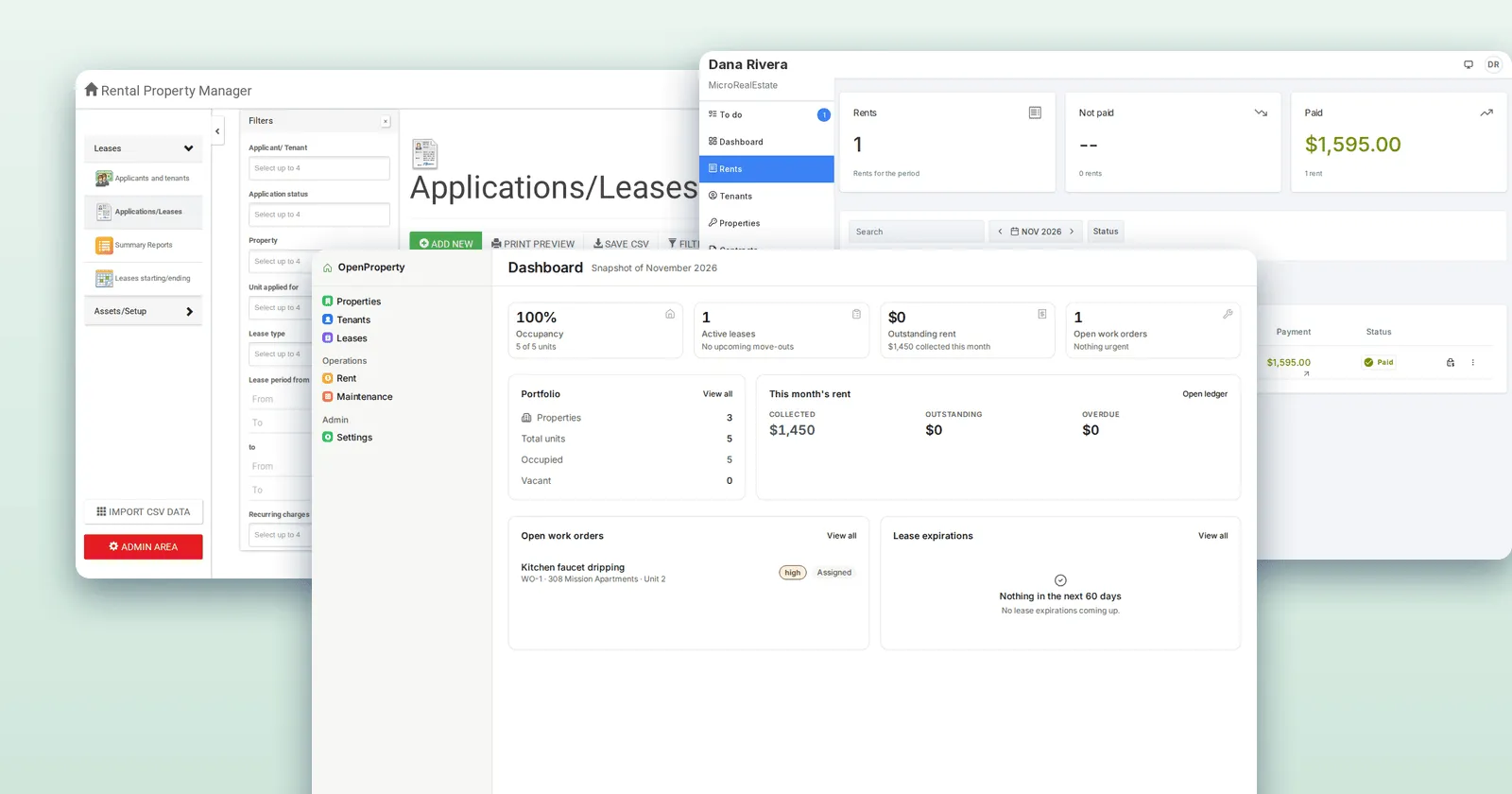
Best Open Source Property Management Software (2026): We Installed 4
We installed OpenProperty, ORPM, MicroRealEstate and Movin' In and timed each to a working login. How to get each running, and who each one suits.
By Yas Rajah
· 18 min read
Contents
- The short answer
- How we tested
- 1. OpenProperty: rent and repairs, running in a minute
- 2. Online Rental Property Manager (ORPM): detailed records on any PHP host
- 3. MicroRealEstate: the most polished, with a licence to check
- 4. Movin’ In: when renters book and pay online
- 5. Condo: shared buildings, for teams with a developer
- Others we looked at
- What you’d add to any of them
- Getting your vacancies listed from your own software
- FAQ
- Sources
The best open source property management software for most small landlords and property managers in 2026 is OpenProperty if you want rent tracking and maintenance running fast, and Online Rental Property Manager (ORPM) if you want a classic PHP app you can host almost anywhere. MicroRealEstate is the most polished of the four we installed, but it’s now free only for a private landlord with up to five units. Movin’ In suits rentals that renters book and pay for online, and Condo suits companies that run shared buildings. (Disclosure: Reallyo publishes this guide. None of these projects is ours, and none paid to be here.)
We installed the first four on 7 November 2026 and timed each to a working login: between about 1 and 4 minutes of install time, once we knew the fixes below. This is a guide to getting each one working, not a ranking of what they lack. For each project you’ll find what it is, how to install it, what you get once it runs, and who it suits. We ran each one in an isolated Linux virtual machine on a Mac, with made-up data only, and every screenshot below comes from that test.
The short answer
| Project | Best for | Licence | Install method | Time to first login (our test) |
|---|---|---|---|---|
| OpenProperty | Rent ledger, bank matching and maintenance, running in a minute | MIT | Node.js: pnpm install, pnpm dev | About 1 minute (no sign-in locally) |
| ORPM | Detailed applicant, tenant and lease records on cheap PHP hosting | MIT | Copy to a PHP + MySQL server, then a setup wizard | About 2 minutes |
| MicroRealEstate | A private landlord with up to 5 units: rents, receipts, tenant portal | Source available (SUL v2.0) | One-line installer on Linux (Docker) | About 3 minutes, after three fixes |
| Movin’ In | Rentals booked and paid for online, by the night, week or month | MIT | Docker Compose | About 4 minutes |
| Condo | Companies running condo and shared buildings, with a developer | MIT | Developer setup (Postgres, Redis, Node) | Not install-tested |
Times are machine time on our test VM: downloads, builds and the first sign-in, with the fixes already known. Your first try will take longer while you read the docs.
Our take: pick by the job, not by GitHub stars. When your week is rent and repairs, start with OpenProperty. For applications and lease paperwork shared by a few people in the office, ORPM. A private landlord with five units or fewer who wants a tenant portal should try MicroRealEstate, as long as its licence fits.
Which open source property management software fits you?
3 questions, 10 seconds. Get the project to install first.
Question 1 of 3
What do you most need it to do?
Question 2 of 3
How many units, and whose are they?
Question 3 of 3
Where would you run it?
Your answer
Start with OpenProperty
It installed in about a minute in our test, with two commands and Node.js. You get a rent ledger with bank-statement matching, late-rent reminder drafts and maintenance work orders. It has no sign-in when run locally, so keep it on your own computer or add a login before you host it.
Or build your own systemYour answer
Start with Online Rental Property Manager (ORPM)
It runs on XAMPP or ordinary PHP hosting with a setup wizard, and keeps detailed applicant, tenant and lease records for several users. Click "Start using your application" in the same window after setup, and delete the demo date script in hooks/footer-extras.php before you enter real leases.
Your answer
Try MicroRealEstate, if its licence fits
It has rent tracking, emailed receipts and a tenant portal, and installs with one command on Linux. It's source available: free for a private landlord with up to 5 units outside any business, with a paid licence beyond that. On a Mac or ARM machine, run it in an x86 Linux setup as described above.
Your answer
Look at Movin' In
It's built for rentals booked by date, with a renter website, a mobile app and Stripe or PayPal checkout. It ran with Docker Compose in about 4 minutes in our test; set the same database password in all four places, and set up email before renters sign up.
Want the detail?
We’ll send the full breakdown, plus practical listing-marketing guides.
No spam, unsubscribe anytime.
How we tested
We followed each project’s own install instructions, from its README or wiki, and timed the run from the first download to a working signed-in screen. Then we entered the same made-up landlord, property, tenant and lease into each one and screenshotted the main screens. Every problem we hit is listed with its fix, in the sections below and in the picker above.
Our test machine was an Apple silicon Mac, but nothing ran on the Mac itself. Each project ran in containers inside a Linux virtual machine that could see only an empty folder: no access to the Mac’s files, no ports open to the network, and a fresh browser with no bookmarks or saved sign-ins. That’s a sensible way to try any self-hosted software before you trust it with tenant data.
We didn’t test on Windows. Windows steps come from each project’s own docs, and we say so wherever they appear.
1. OpenProperty: rent and repairs, running in a minute
OpenProperty is a property management app for “landlords and small property managers”, in its README’s words, published as an open-source app template by Clawnify. It’s MIT licensed, written in React and TypeScript, and stores everything in one SQLite database. The latest change we tested was from 29 October 2026.
How to get it running. You need Node.js 22 or later and pnpm (run corepack enable to turn it on). Then:
git clone https://github.com/clawnify/OpenProperty.gitandcd OpenPropertypnpm installpnpm dev- Open
http://localhost:5173
That took about a minute in our test, including the downloads, with no errors. It runs the same way on Mac, Windows and Linux, since it only needs Node.js. There’s no sign-in when you run it locally, so it opens straight on the dashboard. Keep it on your own computer, or add a login before you put it on the internet. The first run adds three sample properties, five units and three vendors; delete them before you add your own.
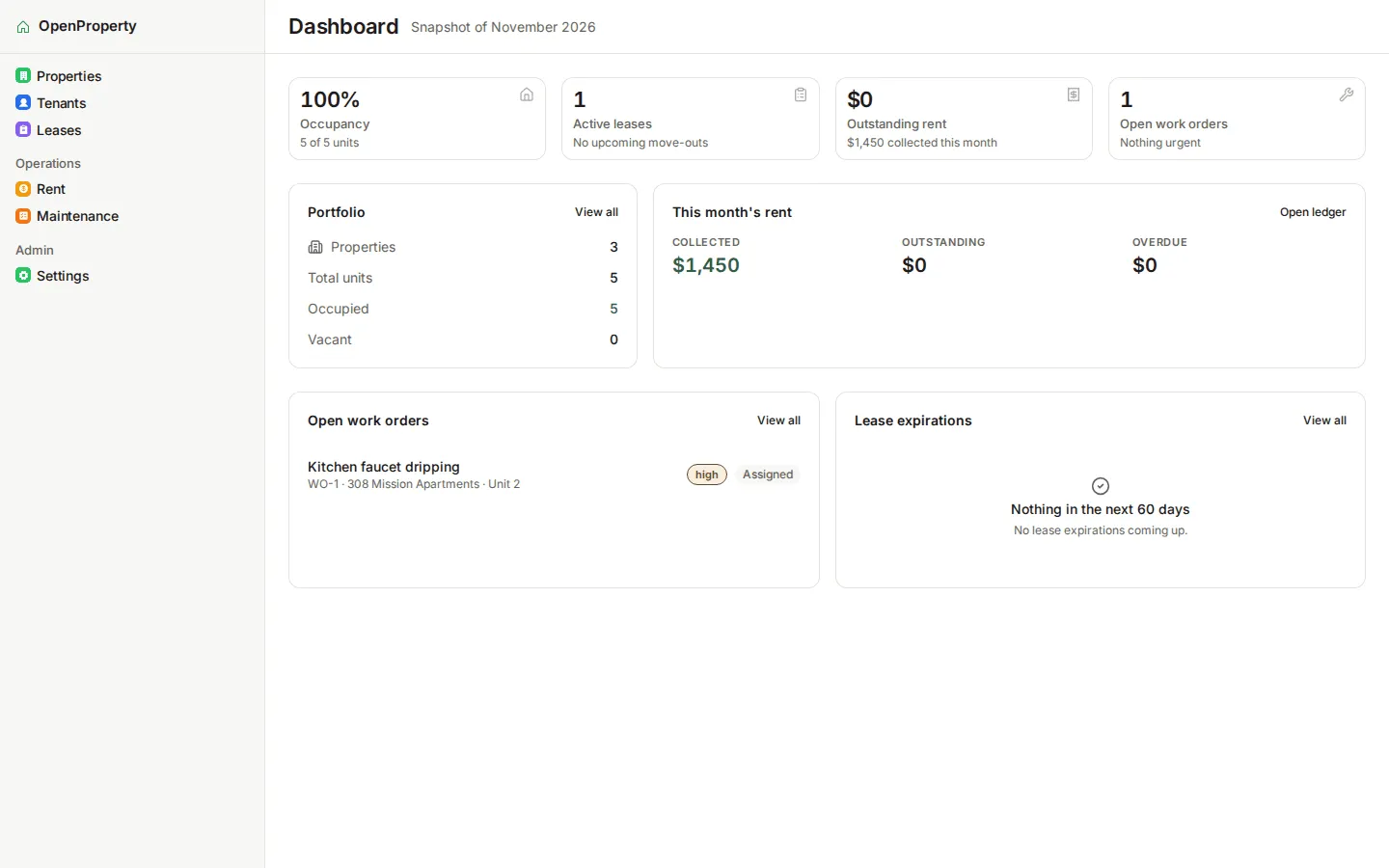
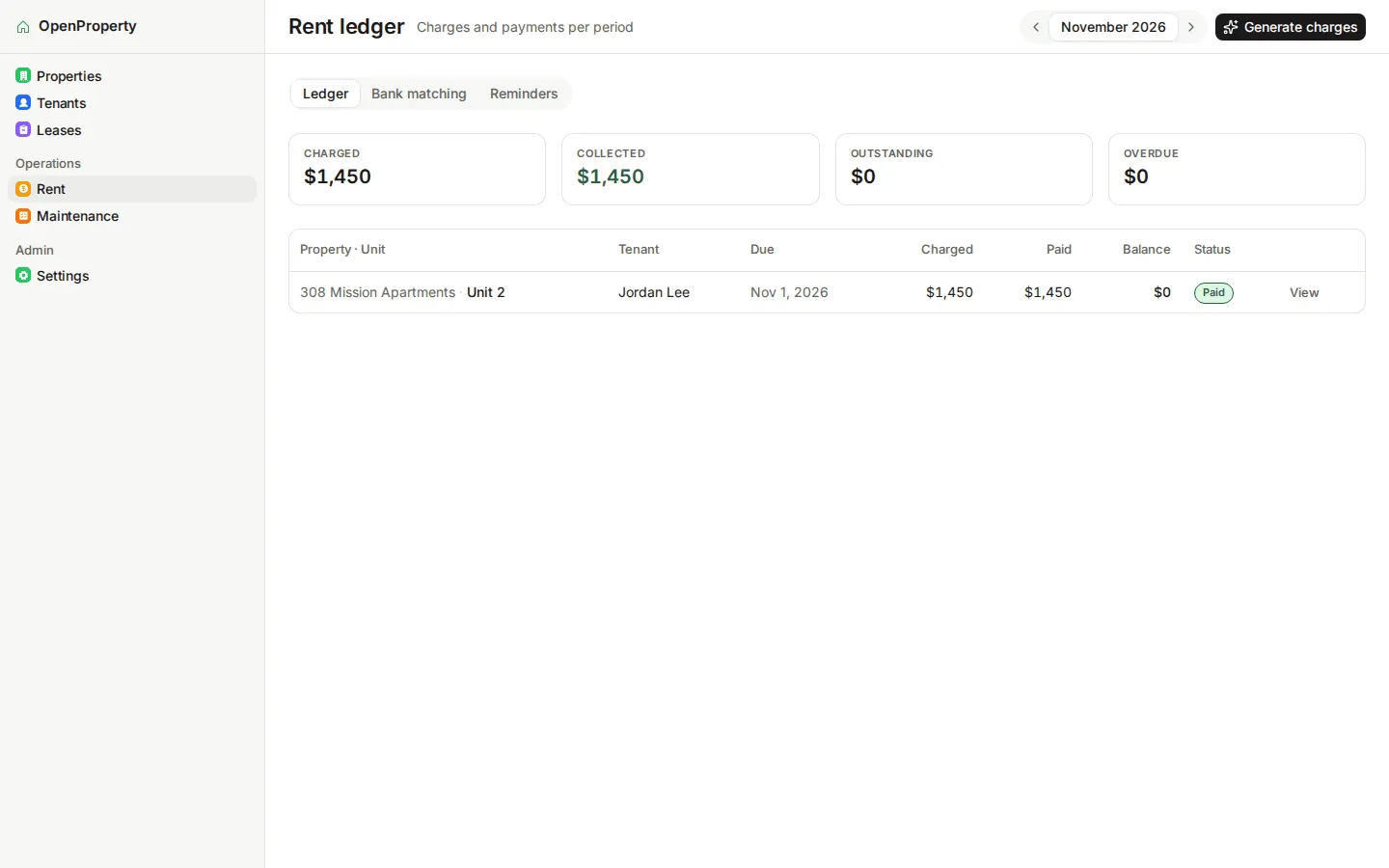
What you get. A dashboard with occupancy, rent collected and outstanding, open work orders and leases ending soon. Properties and units, tenants, and leases with rent, deposit, due day, late fee and more than one tenant per lease. A monthly rent ledger where you generate the month’s charges with one click and record each payment by amount, method, date and reference. It can also match payments from a bank statement (CSV, or CAMT.053 from a European bank), and it drafts late-rent reminder emails for you to send from your own email.
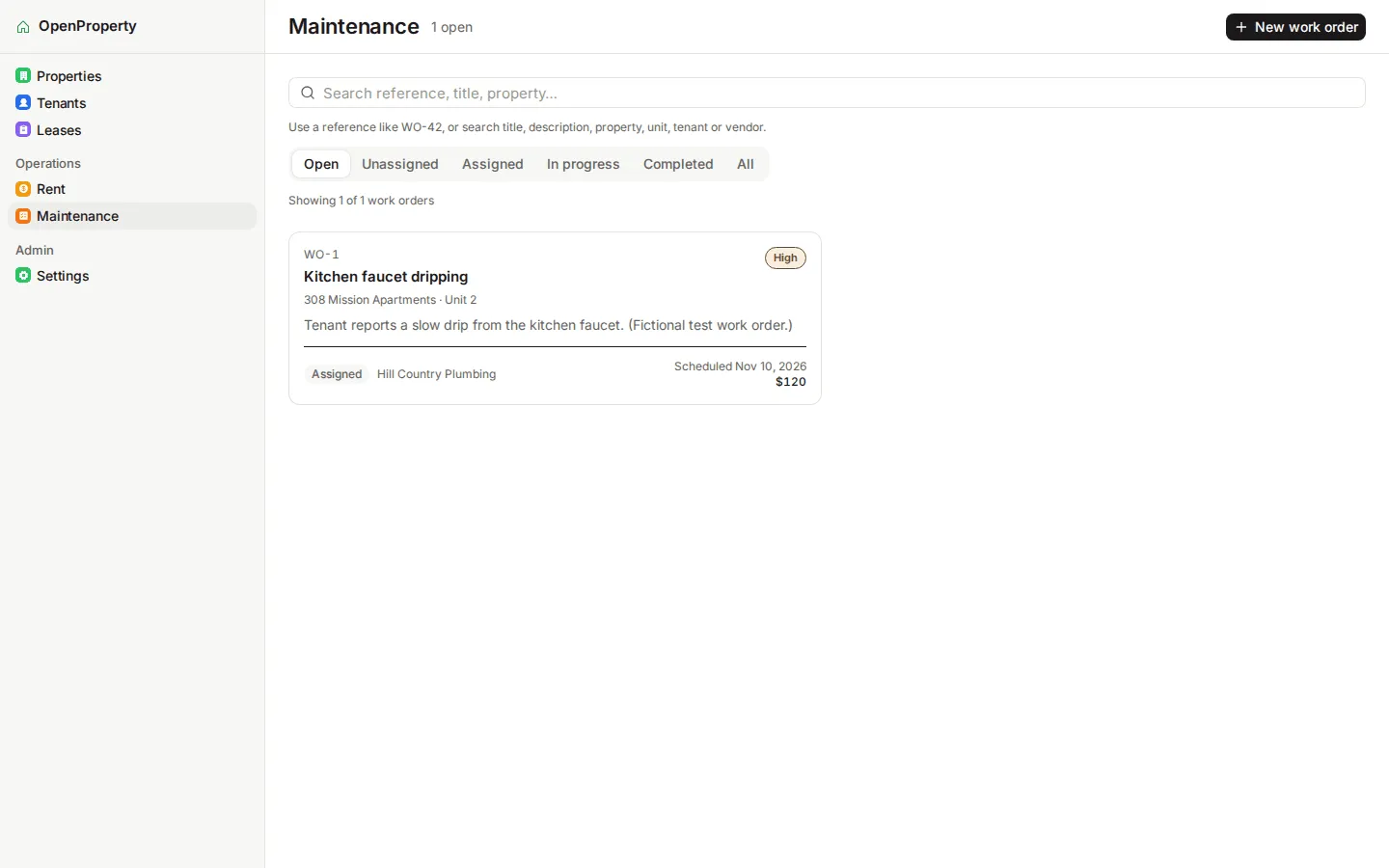
Maintenance is a list of work orders, each with a priority, status, vendor, scheduled date and cost, and a reference like WO-1 for phone calls.
Who it suits. A landlord or small property manager who’s comfortable running a Node.js project, and wants the day-to-day jobs (who has paid, what needs fixing) more than paperwork.
What you’d add separately. The README is clear about what it leaves out: “There is no card or bank processing”, no credit or background checks, it doesn’t send messages itself, and there’s “No listing syndication, and no public tenant or owner portal”. As it puts it, “Each of these can be built on top once you have your own copy.”
2. Online Rental Property Manager (ORPM): detailed records on any PHP host
ORPM is a free, MIT-licensed app from BigProf for managing “landlords, rental properties, units, applications, leases and tenants”. It’s a PHP and MySQL app built with AppGini, BigProf’s app generator (AppGini itself isn’t open source, the README notes, but you don’t need it to run ORPM). The release we tested, 26.14, came out on 13 July 2026, and there’s a live demo (user demo, password demo).
How to get it running. The README’s route is XAMPP, which bundles Apache, PHP and MySQL for Windows, Mac and Linux:
- Install XAMPP and start Apache and MySQL.
- Download the latest release from GitHub (“Source code (zip)”) and unzip it.
- Copy the contents of its
appfolder into a folder in XAMPP’shtdocs(on Windows,C:\xampp\htdocs). - Create an empty database and user in phpMyAdmin.
- Open
http://localhost/your-folder/and follow the setup wizard: database details, then an admin username, email and password. - When it says Success, click “Start using your application” in the same browser window.
- Before you enter real leases, open
hooks/footer-extras.phpand delete the first<script>block, the one that callshooks/ajax-update-dates.php.
We ran the same steps with PHP 8.3 and MariaDB 11 in containers, and reached a working login in about 2 minutes. Two of those steps come from problems we hit:
- Step 6. The wizard signs you in, and that first visit to the app creates its user tables. We opened the app in a fresh browser instead, and every page failed with a PHP “Allowed memory size … exhausted” error. Running the wizard again and clicking through in the same window fixed it.
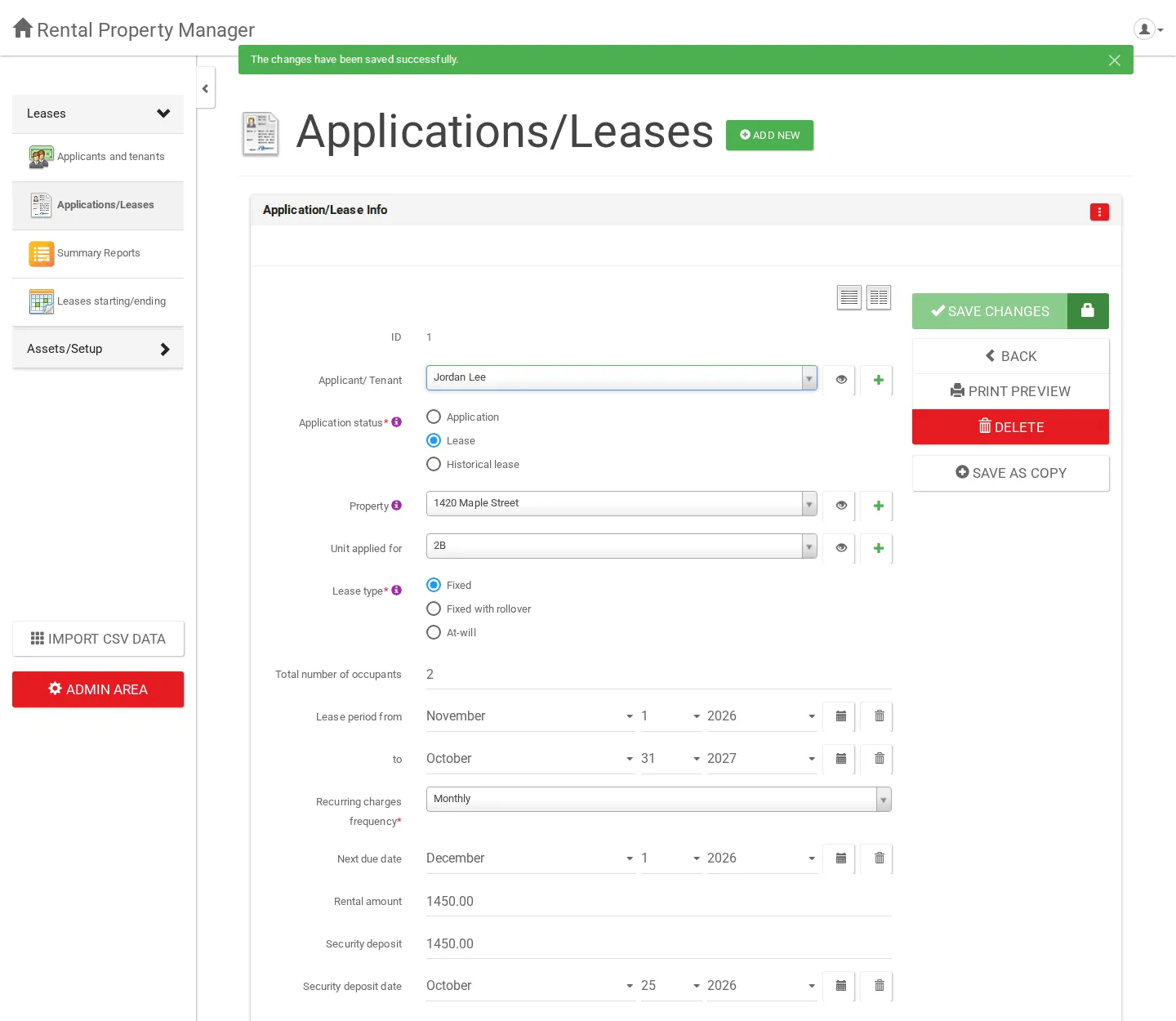
- Step 7. The release includes a script that keeps the public demo’s dates looking current. It runs on every page load and moves lease dates so the newest lease started two years ago. A lease we entered for November 2026 to October 2027 was saved as 2024 to 2025. With that block deleted, dates stayed as entered.
If you use your own server instead of XAMPP, it needs PHP 7.0 or later with the mysqli extension (the official PHP Docker images don’t include it), and MySQL 5.6+ or MariaDB 10+. Without the PHP GD extension, the setup page warns that uploaded photos won’t get thumbnails.
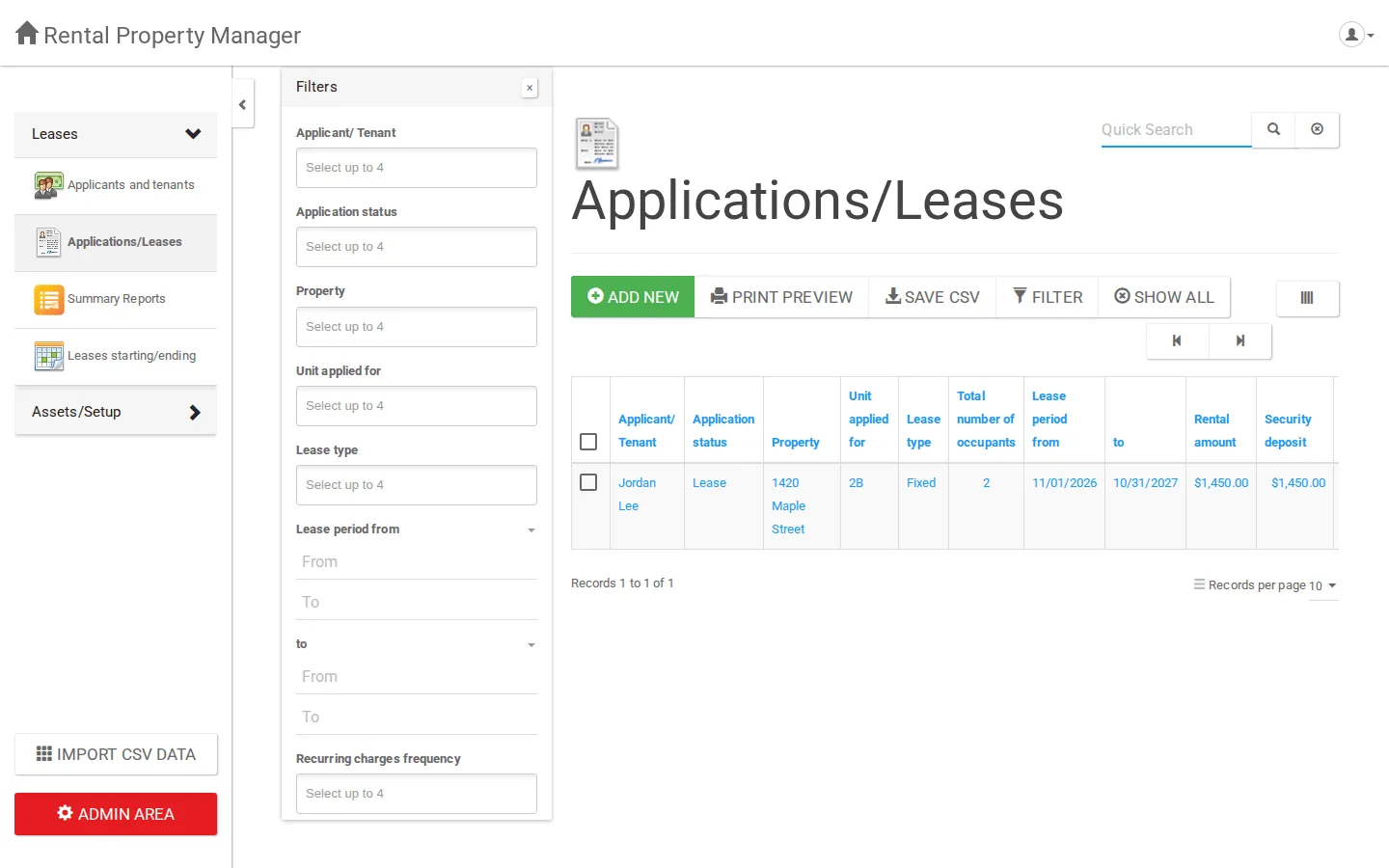
What you get. Landlords, properties and units (with status Occupied, Listed or Unlisted, features and rent). Applicants and tenants with income, employment history, rental history and references. Applications and leases with term type (fixed, fixed with rollover or at-will), dates, recurring charges, deposit, co-signer and notes. Five summary reports, a calendar of leases starting and ending, CSV import and export, and several users with permissions by table.
Who it suits. An office that cares about records: applications, lease details and who can see what. Its PHP and MySQL stack runs on XAMPP or on most cheap web hosting, which makes it the easiest of the four to host.
What you’d add separately. Rent tracking and payments (it has no rent ledger), maintenance requests, a tenant portal, screening, e-signatures and listing your vacancies.
3. MicroRealEstate: the most polished, with a licence to check
MicroRealEstate is “a self-hosted property management application for landlords”, with rent tracking, rent notices and receipts, and a tenant portal. It runs as Docker microservices with MongoDB. The release we tested, v1.1.0, came out on 25 October 2026.
Is MicroRealEstate open source? Not under its current licence, and the project says so itself: “MicroRealEstate is source available under the Sustainable Use License (SUL) v2.0.” Since 11 February 2026 it’s “Free for a private landlord managing up to 5 rental units, outside any professional, business or revenue-generating activity.” Commercial use, which the README says includes “managing more than 5 rental units, and any use for the benefit of third parties”, needs a separate commercial licence from its author. The app shows the cap too: our Properties page read “1 of 5 properties”. Versions up to 9 December 2025 remain under the MIT licence. The Open Source Definition says a licence “must not restrict anyone from making use of the program in a specific field of endeavor”, such as business, which is why “source available” is the accurate label. For a private landlord with a handful of units, it’s still free to use.
How to get it running. The README’s method is one command on a Linux machine, “your laptop, an old desktop, or the cheapest VPS your host sells”:
- Run
curl -sSL https://raw.githubusercontent.com/microrealestate/microrealestate/main/install.sh | bash. It installs Docker if it’s missing and asks for your sudo password, because it uses ports 80 and 443. - Open the landlord address it prints, sign up, sign in, and set up your organisation: name, language and currency.
- Create a contract first (your lease model: name, schedule, number of periods, and any template documents you write yourself), then add a property and a tenant.
On a Mac, the installer stops with “macOS is not supported”, so we ran it in a Linux virtual machine. On Windows, the installer supports WSL2 (Windows’ built-in Linux), which we didn’t test.
It took about 3 minutes once we knew three fixes. The images are built for x86 (amd64) processors only, so on Apple silicon or a Raspberry Pi the download fails with “no matching manifest”. We pulled them with --platform linux/amd64 first, and they ran under emulation, but our 4 GB virtual machine ran out of memory: 8 GB worked. We’d also started from an older copy of the instructions on the master branch, where sign-up kept sending us back to sign-in; the installer from the main branch worked. Sign-in allows 10 tries every 10 minutes, which only matters if you’re testing.
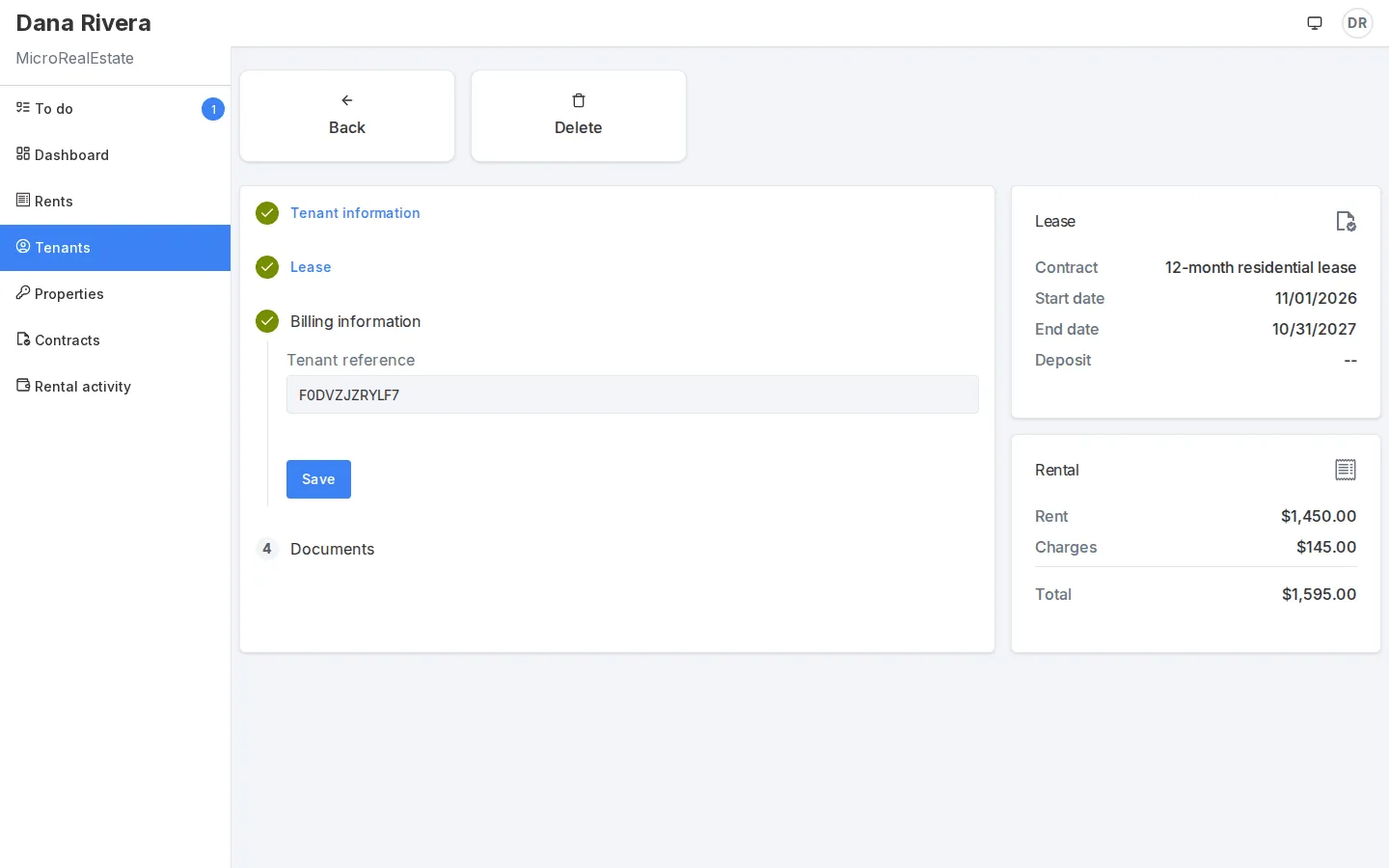
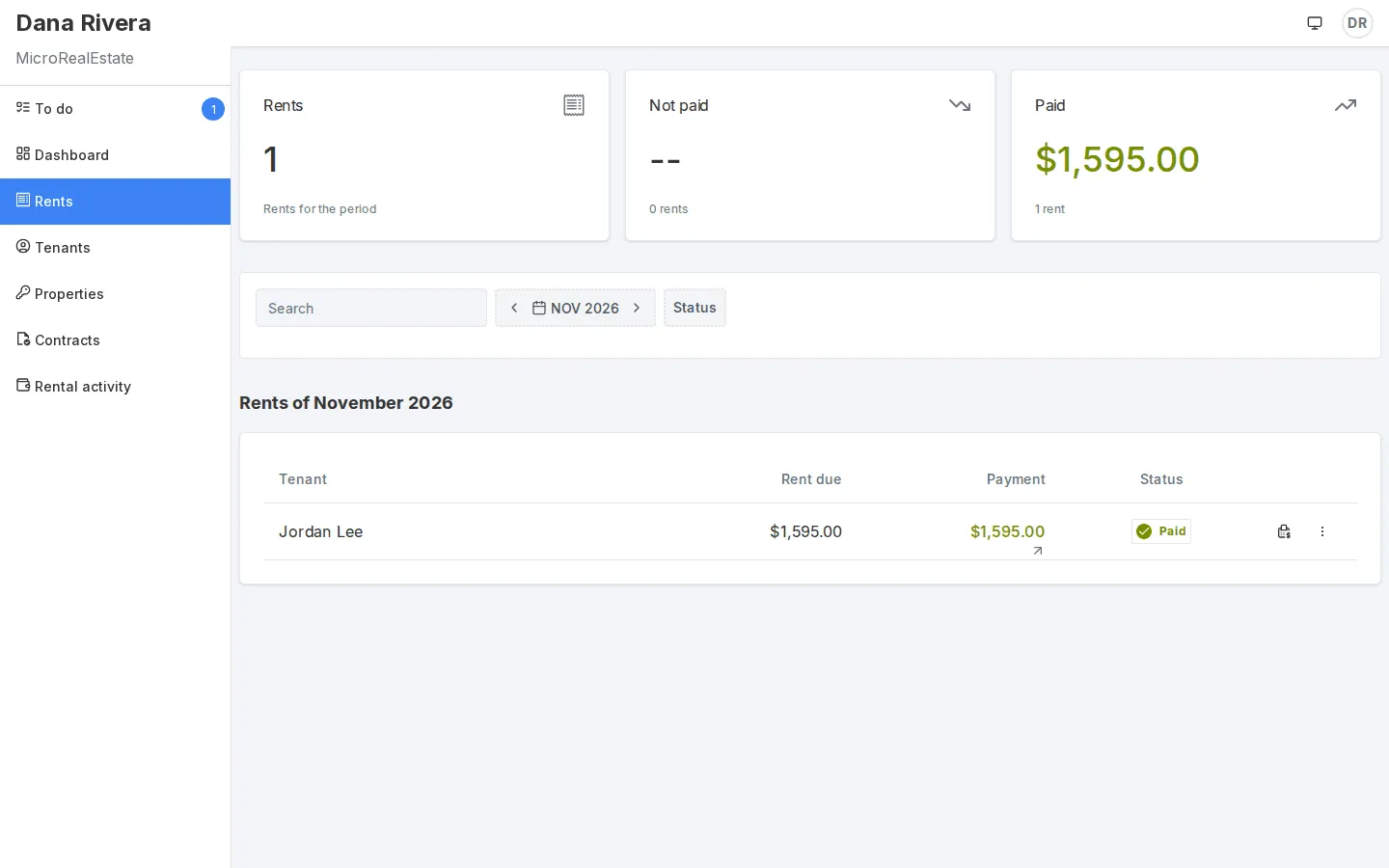
What you get. Properties, tenants and leases built from contract models. A rents page showing who has paid this month, with “Cash a rent” to record a payment. Rent notices and receipts emailed to the right tenants in one pass, and a tenant portal where tenants see their lease, payment history and receipts (both need an email service set up). Five languages and a long list of currencies.
Who it suits. A private landlord with up to five units who has, or will rent, a small Linux machine, and wants receipts and a tenant portal without paying for software. Anyone managing more units, or managing for others, needs the commercial licence.
What you’d add separately. Online rent payments (you record money that arrived another way), maintenance requests, screening, e-signatures and listing your vacancies.
4. Movin’ In: when renters book and pay online
Movin’ In is “an open-source and cross-platform Rental Property Management Platform with an admin panel for managing properties, customers and bookings, a frontend and a mobile app for renting properties”. It’s MIT licensed, actively developed (v7.5 came out on 5 November 2026), and works more like a booking site than a landlord’s ledger: “Prices are set per rental term (daily, weekly, monthly or yearly) and calculated pro rata for the booked period”, with Stripe or PayPal at checkout.
How to get it running. The project’s Docker guide covers Linux and Docker Desktop on Windows or Mac:
git clone https://github.com/aelassas/movinin.gitandcd movinin- Copy
backend/.env.docker.example,admin/.env.docker.exampleandfrontend/.env.docker.exampleto.env.dockerin the same folders. - In
backend/.env.docker, set a database password,MI_COOKIE_SECRETandMI_JWT_SECRET(32 characters or more),MI_ADMIN_EMAILand your SMTP email settings. Put the same database password indocker-compose.yml. docker compose up -d- Sign in to the admin panel at
http://localhost:3003with your admin email and the passwordM00vinin, then change it.
Compose builds three images from the source, which took about 3 minutes; the admin sign-in worked about 4 minutes after we started the download. It built natively on our ARM machine.
A few things to know. The database password appears in four places (the env file, plus the database, its health check and the mongo-express tool in docker-compose.yml). The admin panel and website have the API address built in at localhost:4004, so set your server’s address in the three env files before you build if renters will reach it over the internet. Renter sign-up needs the SMTP settings. And in the admin panel, an agency needs a logo image before it saves; a property then needs a main image, an agency and a location.
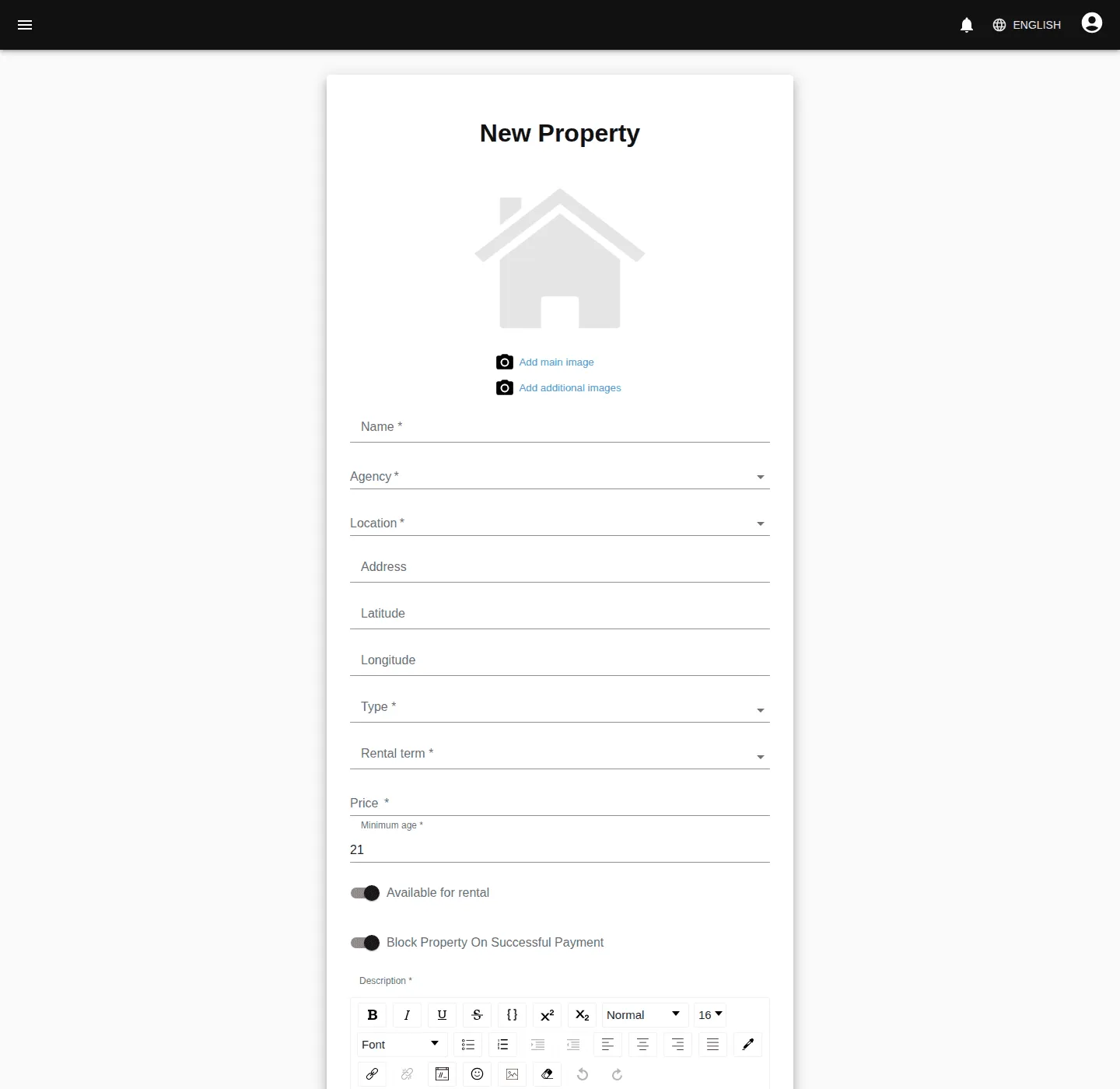
What you get. An admin panel for agencies, locations, properties, renters and bookings, with a scheduler calendar. A public website and a mobile app where renters search by location and dates, then book and pay. Eight languages and 134 currencies.
Who it suits. Agencies doing furnished, short-stay or mid-term rentals, where a renter books a period and pays up front.
What you’d add separately. Long-term lease records and a monthly rent ledger, maintenance, screening, e-signatures and listing your vacancies on the big rental sites (it lists them on its own website).
5. Condo: shared buildings, for teams with a developer
Condo is an MIT-licensed “Open Source property management SaaS that allows users to manage tickets, resident contacts, properties, payment tracking, create invoices, and oversee a service marketplace”, aimed at “property management companies and those servicing shared properties”. It’s very active (release 5.33.0 on 5 November 2026).
We didn’t install it. Its README describes a developer setup in seven steps (PostgreSQL 16.4 and Redis 6.2, then installing and building its packages, preparing the app, and starting the app and a background worker), which is a job for a developer rather than a 45-minute landlord install. If you run condo or homeowners’ association buildings and have a developer, it’s the one to look at.
Others we looked at
- Parcelis (AGPL-3.0) aims at “landlords, small operators, and local property teams”, with properties, units, tenants, leases, maintenance and income. Its README says it’s “not production ready” yet, so we left it out of the test. Worth watching.
- OpenKOS (Apache-2.0) is for “boarding houses (kos), apartments, and rentals”, built with Laravel and React, with rent reminders over WhatsApp.
- PropMS adds property management (leases, meters, key sets) to ERPNext, the open-source ERP. It was last updated in August 2024, so check it works with your ERPNext version first.
- QloApps is the most-starred “PMS” on GitHub, but it’s a hotel booking system: the other meaning of property management system.
- real-estate-management shows properties on a map and takes inquiries; its README marks both halves as work in progress.
What you’d add to any of them
Apart from Movin’ In’s booking checkout, none of the projects above takes rent online, screens applicants, collects e-signatures or sends your vacancies to rental sites. That’s normal for free software: each of those needs an outside company, an approval process and usually a fee per use. Plan for four add-ons:
- Collecting rent online: a payment processor, linked to the rent ledger by hand or by its API.
- Screening: a screening service, usually paid by the applicant.
- E-signatures: an e-signature service for leases and addendums.
- Listing vacancies: a listing syndication service, or posting each listing on each site by hand.
Getting your vacancies listed from your own software
If you run one of these, or build your own, listing vacancies is the piece that stays manual. Reallyo’s Listings API and MCP server take rental listings from your own software (or from Claude or ChatGPT) and publish them to Reallyo’s partner rental network, including Zillow, Apartments.com, Realtor.com and Zumper. Photos must be at public links, so the API can fetch them. It’s included on every plan, the free one too: see the Listings API. And if you’d rather build your own system than adapt one of these, our guide to building your own property management software covers the property management side step by step.
FAQ
Is there free open source property management software? Yes. OpenProperty, Online Rental Property Manager (ORPM), Movin’ In and Condo are free under the MIT licence, and you can run them on your own computer or server. MicroRealEstate is free for a private landlord with up to five units under its source-available licence. You pay only for hosting, if you host it online.
Is MicroRealEstate open source? Not since 11 February 2026. Its README says it’s “source available” under the Sustainable Use License v2.0: free for a private landlord with up to five units outside any business, with a paid licence for commercial use, more than five units or managing for others. Versions up to 9 December 2025 remain MIT.
Which open source property management software is easiest to install? In our test, OpenProperty: two commands and about a minute, with Node.js installed. ORPM is the easiest to host, because it runs on XAMPP or ordinary PHP web hosting with a setup wizard.
Can I run open source property management software on Windows? Yes. ORPM runs on XAMPP for Windows, OpenProperty needs only Node.js, Movin’ In’s docs cover Docker Desktop on Windows, and MicroRealEstate’s installer supports WSL2. We tested on Linux, not Windows.
Which one has a tenant portal? MicroRealEstate has a tenant portal for leases, payments and receipts, and Movin’ In has a renter website and mobile app for booking. OpenProperty and ORPM don’t include one.
Do I need to know how to code? Not to install ORPM, which has a setup wizard. The others need a terminal: copying commands, editing a settings file and running Docker or Node.js. Changing how any of them works means editing code.
Can open source property management software post my listings to Zillow? None of the projects we looked at does it on its own. You’d connect a listing syndication service through its API, or post each listing by hand.
Free syndication & listing marketing
List Once. Syndicate and Market your listings. Everywhere.
Reallyo sends your rental to Zillow, Apartments.com and the rest of its partner rental network, then turns it into a listing page, a video, social posts and flyers. Free for one active listing, no card.
Sources
Each project’s own pages, checked 7 November 2026:
- OpenProperty: README and code
- Online Rental Property Manager: README, release 26.14, live demo
- MicroRealEstate: README, LICENSE.md
- Movin’ In: README, Docker guide
- Condo: README
- Parcelis, OpenKOS, PropMS, QloApps, real-estate-management: each project’s GitHub README, linked above
- Open Source Initiative: The Open Source Definition
- Our install test: four projects in an isolated Linux virtual machine on a Mac (Ubuntu 24.04, 4 CPUs, 8 GB), 7 November 2026, made-up data only